Storing and transporting your detector without damage: batteries, cases, and the monthly check
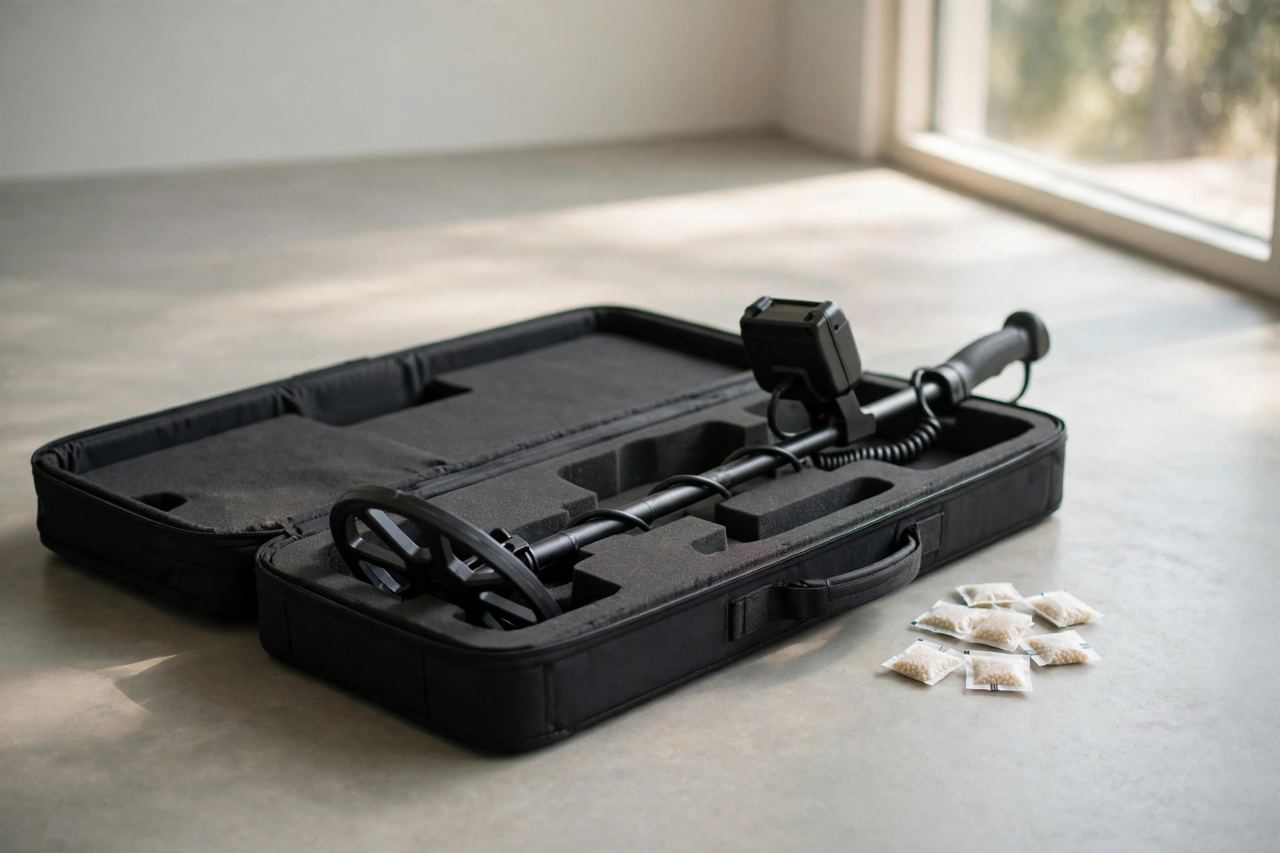
What actually kills a metal detector: a leaking battery, a summer in a hot trunk, or one unpadded ride across a washboard road? In practice it is rarely a dramatic accident. Detectors die quietly in storage, one corroded contact and one cracked cable at a time, and the damage is usually discovered on the first hunt of spring, in a field, an hour from home. Three mistakes account for most of it. Each one is cheap to prevent.
Mistake one: batteries left in over the off season
This is the single most damaging habit, and the easiest fix. Batteries left in a stored detector can leak, and the corrosion attacks the contacts and works inward while the machine sits. The rule from storage guidance is plain: remove the batteries for any storage longer than two weeks. Every battery, not just the main pack: the pinpointer and the wireless headphones get emptied too, because they corrode on exactly the same schedule. Store removed rechargeable batteries at roughly 40 percent charge in a cool, dry place, and look them over every three to six months for leakage or charge loss. One cold weather warning belongs here: never charge lithium ion cells below freezing. Cold charging damages the cells permanently, so a battery that spent the night in a cold car gets warmed to room temperature before it goes on a charger.
Mistake two: the hot car and the damp garage
Storage guidance puts the safe band at 10 to 35 degrees Celsius, in a dry place, with humidity roughly between 30 and 75 percent and never condensing. Published guides vary a little inside that envelope (one winterizing guide suggests a narrower humidity band), so treat the wide band as the outer fence and aim for the middle of it: an indoor closet or a climate controlled room beats an uninsulated garage on both temperature and damp. Keep the detector away from heating vents, open windows, and direct sun, all of which swing temperature and humidity daily. Inside the case, silica gel packets earn their space by absorbing the moisture that does get in. The failure mode to picture is condensation: a cold detector brought into warm, damp air collects moisture on its boards and connectors, so let a cold machine warm up gradually, still in its case, before opening it.
Mistake three: loose in the trunk
| Scenario | The damage route | The fix |
|---|---|---|
| Car trunk or truck bed | Impacts and vibration; the coil knocks against hard cargo | Padded, foam lined case, wedged so it cannot slide |
| Carried between spots on foot | Drops, and the coil dragged or banged over rocks and roots | Carry low and centred; lift the coil over obstacles rather than dragging it |
| Cable, any scenario | Strain and snagging at the connector; fraying at bend points | Cable bundled neatly along the shaft with a little slack at the connector, never wound tight or left dangling |
A padded case is doing three jobs at once: absorbing impact, stopping vibration, and keeping the coil from taking knocks that the housing was never built for. The cable deserves the same respect as the electronics. Inspect it before and after each use for cracks, tears, and corrosion at the connectors, and treat a bent pin or a frayed section as a repair now item, not a quirk: cable faults cause falsing and dropouts that look exactly like a failing detector.
The storage routine, in order
- Clean the coil and control housing after the last hunt: a soft cloth, mild soap and water for stubborn grime, and no water forced into control box openings.
- Dry everything thoroughly. Moisture sealed into a case is worse than moisture left in open air.
- Remove every battery: detector, pinpointer, headphones. Store rechargeables at roughly 40 percent charge, cool and dry.
- Coil cover on, cable bundled along the shaft with slack at the connector, machine into its padded case with silica gel packets inside.
- Case into a dry indoor spot inside the 10 to 35 degree band, off the floor where possible.
- Success looks like this on the first spring hunt: clean contacts, a cable with no cracks, and a machine that powers up and ground balances normally.
The monthly five minute check
Storage is not a set and forget state. Once a month, open the case and run a short inspection: look for cracks in the coil and housing, corrosion on battery terminals and connector pins, frayed or stiff cable sections, and debris built up around the coil cover. Catching any of these in the case, in winter, costs a cloth, a contact cleaner, or a cable. Catching them in a field costs the hunt. Five minutes a month is the cheapest insurance a detector owner can buy, and unlike most insurance, it pays out in hunts that simply work.
Accessories follow the same rules
The detector gets the attention, but the kit around it fails on the same schedule. Pinpointers carry batteries that leak on exactly the same terms, and their tips and battery caps wear in gritty soil. Headphones, wired or wireless, dislike damp storage as much as the control box does, and a coiled headphone cable stored under tension takes a permanent set. Digging tools are the forgiving end of the kit, but a steel digger stored wet in the same case will rust against everything it touches. The routine scales down without changing shape: batteries out of every powered accessory, everything cleaned and dried before it goes into the case, steel tools wiped and stored dry, ideally in their own pouch or compartment. When the case opens in spring, the whole kit should be hunt ready, not just the machine in the middle of it.
— Tom Reilly, Home & DIY Writer