Metal Detecting for Kids, Safely: Roles, Rules, and a First Hunt That Works
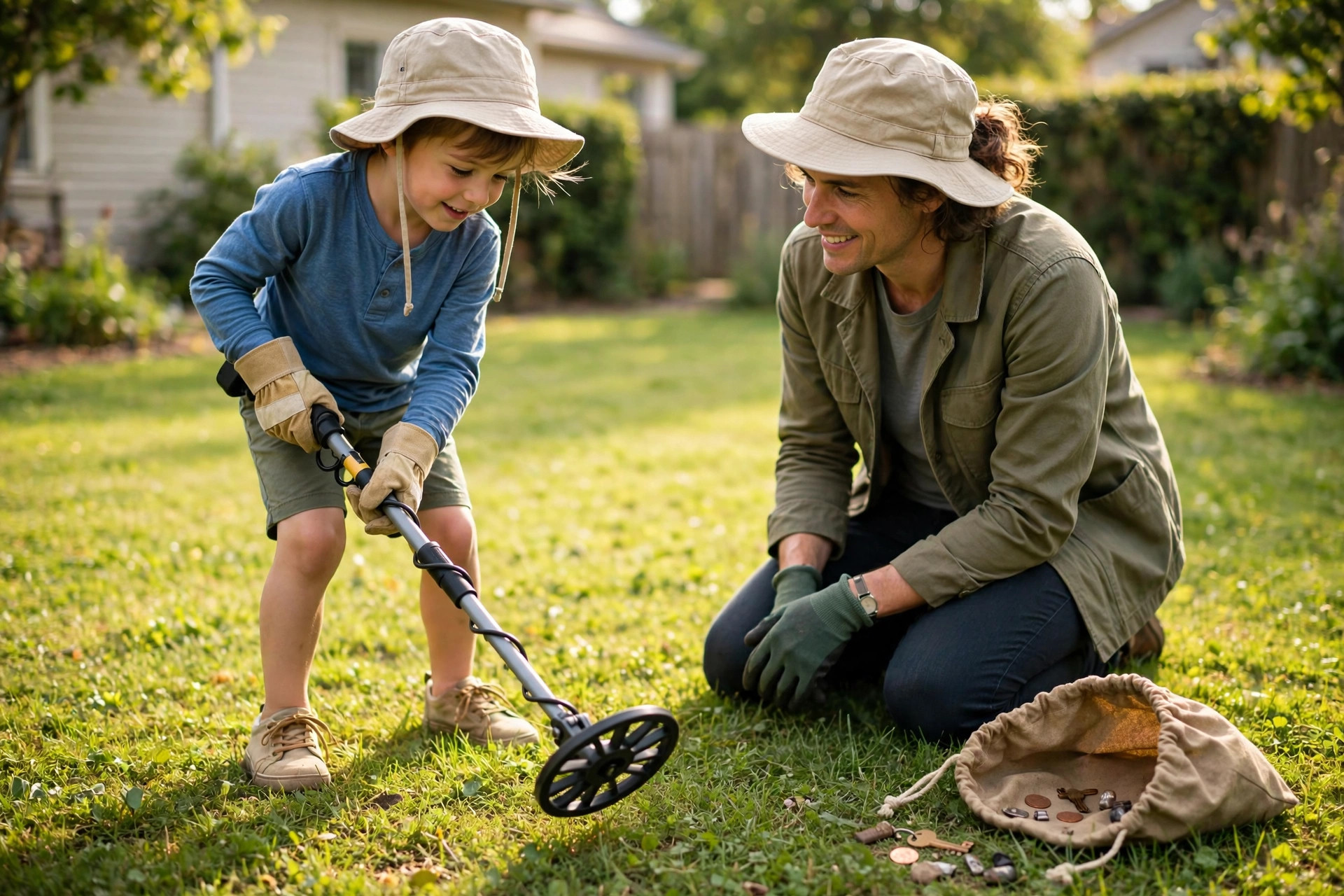
Most guides to detecting with children are shopping lists sorted by age. Shopping is the easy part. The hard part, the part that decides whether a child is still keen by the third outing, is session design: who holds what, who digs, what happens when something sharp comes out of the ground, and how long the hunt lasts. This guide is built around those decisions. It uses the age guidance manufacturers and retailers publish, but organises the day by roles rather than by products, because a well-run first hunt with a borrowed detector beats a badly run one with a brand-new box.
Safety note: this is general information for families, not a substitute for your own judgement, local rules, or medical advice. Adults supervise, adults handle anything sharp, and local permission rules apply to children exactly as they do to adults.
Start with roles, not with a detector
The age bands in retailer guidance are consistent in outline. Regton's parent guide suggests very lightweight, simple, supervised detecting for ages 3 to 5, entry-level children's detectors for 5 to 7, children's or lightweight adult machines with more target identification for 7 to 10, entry-level adult detectors for 10 to 13, and adult beginner detectors from 13 up, while stressing that age is a guide, not the deciding factor, because children vary in height, strength, and patience. Garrett's family guidance lands in the same place: most kids can start around ages 6 to 8 with supervision and a junior-sized or beginner detector that fits their height and strength, and adult models can simply be too heavy or complex. A state-parks guide to kids' detectors makes the depth question reassuring: coin-size targets at roughly 4 to 6 inches is the realistic range for junior machines, and that is plenty, because most finds in child territory are recent drops in the top few inches of sand or lawn.
Roles make those bands workable in a mixed-age group. The swinger carries the detector and owns the slow, overlapping sweep. The pinpointer holder kneels at each signal and narrows the spot, the state-parks guide notes that younger siblings often do better holding the pinpointing role while someone else swings, which gives a five-year-old a real job instead of a spectator's exile. The recorder keeps the finds pouch, bags the trash separately, and logs where each find came from. Digging is an adult job at first, shared later under the rules below. Rotate the fun roles every fifteen minutes or so; nobody's childhood memory should be forty minutes of carrying the pouch.
The safety rules that are not negotiable
Children's detecting safety guidance from the Treasure Valley club is blunt on the first point: an adult supervises, always. The same guidance lists the working kit, check for sharp objects, wear gloves, protect against sun with sunscreen and a wide-brimmed hat, be aware of water hazards, and carry a first-aid kit. The club's family guide fills in the digging mechanics: sturdy gloves, a wide-brimmed hat, sunscreen, and closed-toe shoes as the standard outfit; a hand trowel used at about a 45-degree angle rather than with forceful stabbing motions; and the plug method, a neat horseshoe-shaped flap, folded back and replaced properly, taught from the first hole.
The sharp-find rule deserves its own paragraph, because it is the moment hunts actually test. Buried metal is often sharp metal: torn cans, broken glass in the soil, rusty nails. The family rule that matches the club guidance is simple and absolute, a child who uncovers anything sharp stops, hands off, and calls the adult; the adult extracts it with gloved hands, bags it as trash, and the child never carries sharp finds in a pocket or a bare hand. DetectorPower's family guide makes the companion point about structure: set clear rules about digging and handling finds before the hunt starts, not after the first exciting beep, and give everyone gloves for digging. Add hand-washing before snacks. Garrett's own family gear checklist includes a small first-aid kit and snacks side by side, and the order those two get used in matters.
Choosing a first detector without overbuying
Three checks, all drawn from the guidance above, beat any feature list. Weight first: the club's family guide suggests lightweight models around 1.5 to 2.5 pounds are easier for young children to handle, and Garrett's warning that adult models can be too heavy for kids gives the same test from the other side, if a child cannot swing it level for ten minutes, it is the wrong detector, whatever the box says. Fit second: Regton's age ladder pairs the youngest bands with a short stem, which is the practical version of the same point, shaft length should match the child's height, because a detector sized for an adult teaches a hunched, swinging-from-the-shoulder technique that finds nothing and aches quickly. Simplicity third: match controls to the band, simple controls for the youngest children, more features and target identification only from about 7 to 10 up, per Regton's table, and Regton adds the money-saving option retailers rarely volunteer: if you are not sure the interest will last, a good used detector or hiring one is worth considering. A waterproof coil, where a model has one, opens beach and puddle hunting; it is a bonus, not a requirement.
The first hunt: plant the garden, then hunt real ground
Family guides agree on the practice step, one suggests hiding coins or small metal objects in your own backyard so a child learns the machine in a controlled environment, and on the emotional step: set realistic expectations early, because not every beep means treasure, and celebrate every find, rusty or shiny, so motivation survives contact with real ground. Put together, the first session runs like this:
- Before the child arrives, bury a handful of coins and a couple of larger, safe metal objects at shallow depths in your own yard or another spot you have permission for. Note roughly where each one is.
- Kit everyone out: gloves, closed-toe shoes, hat and sunscreen, water and snacks, first-aid kit in the bag. State the rules out loud, adult digs or supervises digging, sharp means stop and call, every hole gets refilled.
- Air-test first: pass known coins over the coil on the surface so the child hears what a coin sounds like before the ground adds its noise.
- Hunt the planted patch with roles assigned. The child swings slowly; at each signal, the pinpointer holder narrows it; the adult cuts the horseshoe plug; the child recovers the target from the plug with gloved hands if it is safe, and the recorder bags it.
- Refill and replace every plug as you go, pressing it back level, and scan the repaired spot, restoration is part of the find, not homework after it.
- Finish while it is still fun. Move to real ground, a beach, park, or schoolyard where detecting is allowed, for the last stretch, with expectations reset: real ground pays slower than a planted garden.
What success looks like: the child can explain the sharp rule unprompted, every plug in the garden has vanished back into the lawn, the trash bag holds more than the finds pouch, and the child asks when the next hunt is. If the finds pouch is the only full measure, the garden was too easy or the session too long, adjust both next time.
Where to go, and the permission habit
Location guidance for families is consistent: beaches, parks, and schoolyards are the usual starting points because the ground is forgiving and finds come steadily, with the permission caveat attached every time. Garrett's family guide states it plainly: many public parks allow detecting, some require permits or have restricted areas, so check with the local parks department or city website before you go. The state-parks guide is stricter for its territory: state park rules vary widely, some states ban detecting, some require permits, some allow only beaches or designated areas, so call the park office first. Teach that check as part of the hobby, done by the child where age allows: asking first is not bureaucracy around detecting, it is detecting. The same guide's advice for a genuinely old find on public land, leave it, note the location, and tell a ranger, is worth teaching verbatim; a child who learns it at eight will never need unlearning it at eighteen.
FAQ
What age can a child start? Guidance converges on about 6 to 8 with supervision and a junior or beginner detector that fits, with younger children joining in non-swinging roles such as pinpointer holder. Age is a guide; size, strength, and patience decide.
What if my child digs up something sharp or strange? Hands off, call the adult. The adult removes it gloved, bags it as trash, and any cut gets cleaned and covered from the first-aid kit. The rule is set before the hunt, so nobody negotiates it over an open hole.
How long should a child's hunt last? Short enough to end on a success. Use the planted-garden session above, rotate roles, and stop while enthusiasm is intact, a child who leaves keen is worth more than one extra hour of pull tabs.
Can kids detect in parks and on beaches? Often, but not by default. Permits, restricted areas, and beach-only rules all exist; Garrett's guidance is to check with the parks department or park office before you go, every time the place is new.