Coin Shooting in Old Yards: Hunt the Pocket Map, Not the Whole Lawn
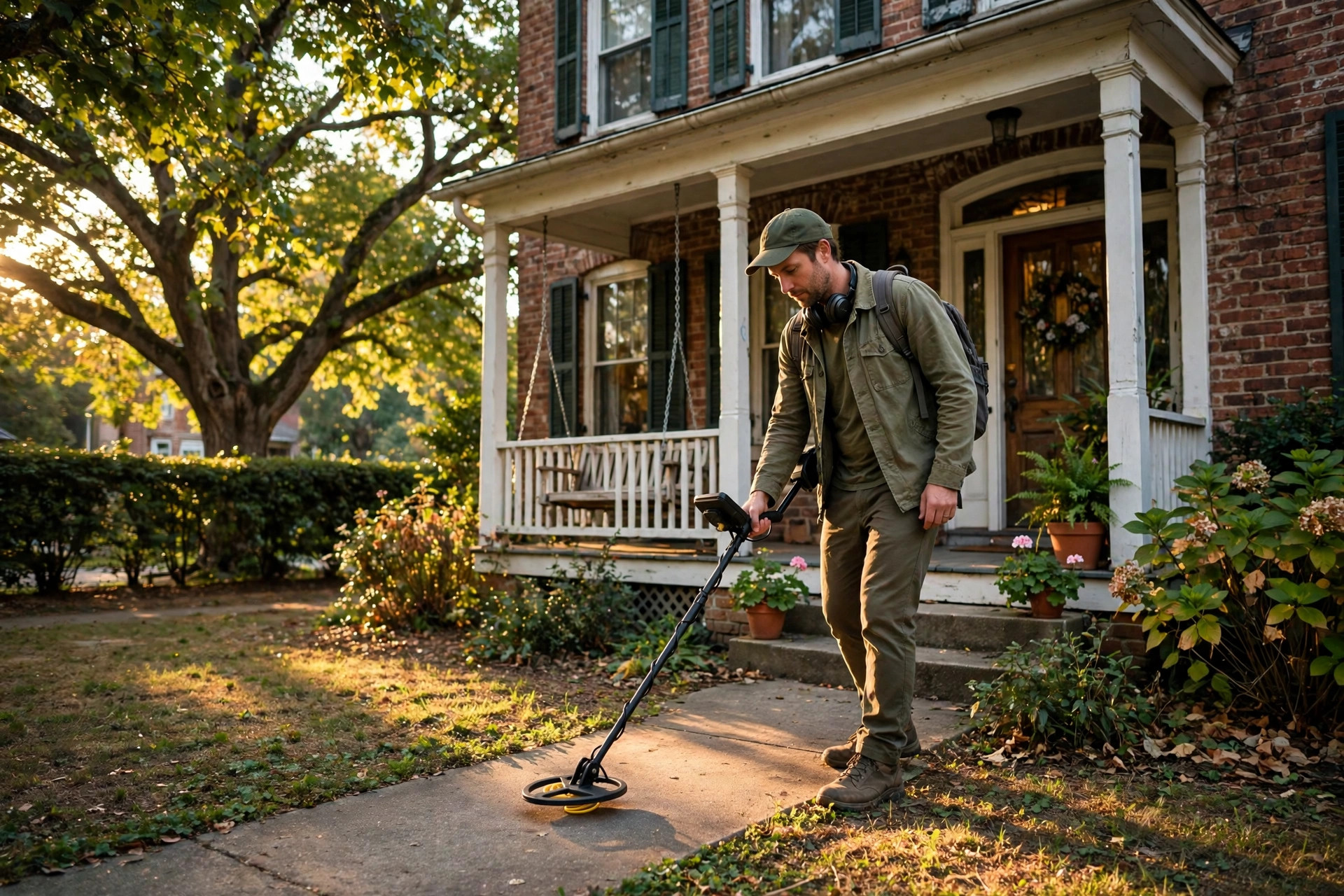
Coin shooting, hunting specifically for coins rather than relics or jewellery, has a natural home: the old house yard. A yard concentrates decades of pocket traffic into a small, griddable space, and unlike a park it has usually been hunted rarely or never. But most advice about old yards is really advice about permission, and most of the rest is forum anecdote. This guide separates the two jobs. First the permission that makes the hunt legitimate and repeatable. Then the part the permission guides skip: a ranked map of the yard itself, built from where people actually reached into pockets, sat down, hung laundry, and fumbled for keys in the dark.
Legal note: this is general information about a hobby, not legal advice. Rules for historic properties and significant finds vary by place; when in doubt, check with the property owner and your local authorities before you dig.
Permission is a document, not a handshake you half-remember
Serious Detecting's laws and ethics guide is direct: private property can offer the most freedom and the best finds, old homesites, farms, and fields holding decades of history, but you must always have permission, and getting it in writing, even a simple email or note, protects both you and the landowner. The guide lists what that writing should confirm: where on the property you may detect, when you may be there, how finds will be shared or handled, and any areas that are off-limits. Its asking advice is equally practical, be polite and specific, explain what you are looking for, state that you use clean digging techniques and fill all holes, and offer to show or share what you find. Agree the find-sharing rule before the first signal, not over the first interesting coin: a yard hunt that ends in an awkward doorstep negotiation about a silver dime is a yard you will not be invited back to.
One boundary matters more in old yards than anywhere else. The same guide's best-practice list says to report significant historical finds, items of possible archaeological or cultural importance, to local authorities or a state archaeologist rather than pocketing them, and historic-district properties can carry extra permit requirements beyond the owner's consent. Everyday pocket change is the quarry here. Anything that looks genuinely historic changes the job from coin shooting to reporting, and knowing that in advance is part of being the guest a homeowner recommends to the neighbours.
Date the yard before you grid it
A beginner coin guide makes the dating point in one useful line: if a property is older than 1965, there is a chance of finding US silver coins, because that is the era boundary for common circulating silver in the United States. The same guide points hunters at their own backyard first, practice, and a test garden of buried known coins, belong at home, and at walkways in the front or back of the house, plus the sites of previous structures such as decks or patios. Dating is not trivia; it sets expectations and search order. A 1920s house justifies a slow, complete grid and a second visit. A 1990s house is a clad-coin and lost-jewellery hunt, still fun, but hunted fast and casually, and nobody should promise its owner a history lesson.
The pocket map: zones ranked by how coins actually fall
Coins leave pockets at predictable moments: hands going in and out for keys, change handed over at a door, trousers inverted on a clothesline, passengers climbing out of cars. MetalDetector.com's neighbourhood coin guide names the classic old-house set directly, search around front porches, back door steps, walkways, and driveways. A homestead guide adds foundations, porches, and cellar doors, plus front yards and large trees where families gathered. Assembled and ranked, the yard looks like this:
| Zone | Why coins collect there | How to hunt it |
|---|---|---|
| Front walkway and sidewalk strip | Keys and change handled at the start and end of every trip out | First pass of the hunt; slow lanes along both edges of the path |
| Porch and front/back door steps | Pockets emptied and refilled at the threshold; change fumbled with keys | Tight, slow grid right up to the steps and along the drip line |
| Driveway and car parking area | Passengers getting in and out; keys retrieved in the dark | Work the edges where gravel or grass met the parking spot, and the path from car to door |
| The clothesline line | Garments hung upside down surrender pocket contents to gravity | Find the line's likely run, post to tree, or back wall to pole, and grid the strip beneath it |
| Big shade trees and gathering spots | People sat, leaned, and emptied pockets where the shade was | Ring the trunk at sitting distance, then the ground under the canopy edge |
| Sites of vanished structures | Old decks, patios, sheds, and earlier buildings concentrated daily traffic | Ask the owner what used to stand where; grid those rectangles even though nothing shows |
Third-party forum reports support the ranking rather than replacing it. In a TreasureNet thread for old-house hunters, one experienced poster advises focusing on the front first, along the walkway and sidewalk and the driveway, and, in the back, looking for the area that could have held a clothesline; the same poster reports a personal ratio of roughly ten wheat cents to one silver coin from 1920s homes, which is a useful honesty check on expectations. A homestead-search guide makes the clothesline mechanics explicit: people have hung clothes upside down to dry for as long as there have been clotheslines, and when coins, watches, and keys were left in pockets, gravity won, so search the straight line between the line's anchor points and back to the house.
A yard hunt, run as a procedure
- Walk the yard with the owner if possible. Confirm the zones, the off-limits areas, where vehicles and pets go, and what used to stand where. Write the find-sharing agreement down if you have not already.
- Date the house and set the expectation out loud: pre-1965 means silver is possible, not promised; a later house means modern coins and jewellery.
- Start at the front walkway and porch, the highest-traffic strip, and work in lanes, marking completed ground by your own footprints or lane markers rather than by memory.
- Move to the driveway edges and the car-to-door path, then the back door steps.
- Hunt the clothesline strip: identify the two most likely anchor points, grid beneath the line between them, and extend the grid a body's width either side.
- Finish with shade trees, gathering spots, and the rectangles where structures used to stand.
- Dig small, refill everything, and remove every piece of trash you recover. Serious Detecting's leave-no-trace list is the standard: fill every hole with no exceptions, carry trash out, and avoid digging near fragile tree roots.
- Show the owner the finds, all of them, including the trash that proves the cleanup, and settle the sharing exactly as agreed.
What success looks like: the lawn shows no trace of the hunt an hour later, the owner has seen everything that came out of the ground, and you leave with either an invitation to return or a neighbour's name. In coin shooting, the second yard a good guest is offered is worth more than any single coin in the first.
"It's been hunted before" is not a verdict
The same TreasureNet thread carries the counter-anecdote, reported as a third-party account: a hunter given permission at a house described as already hunted found a few wheat cents there, and the neighbour, watching, offered her own yard, which produced eleven silver coins, a silver ring, and a bracelet. Treat the numbers as one forum report, not a promise. The transferable lesson is narrower and more reliable: "hunted" usually means hunted once, quickly, by someone who worked the obvious middle of the lawn. Zones survive, the clothesline strip, the walkway edges, the ground under bushes that a swinging coil skips. A virgin-site guide makes the same point about vegetation: search under and through bushes and dense growth rather than leaving them, because the next hunter will. A yard is finished when its pocket map has been worked zone by zone, not when someone says it was visited.
FAQ
What should the written permission actually say? Where you may detect, when, how finds are shared or handled, and which areas are off-limits, per Serious Detecting's ethics guide. A short email covering those four points beats a long verbal understanding.
Which part of a yard should I hunt first? The front: walkway, sidewalk strip, porch, and driveway, per both the dealer coin guide and experienced forum reports. Back-yard clothesline ground comes next.
How do I find a clothesline that is no longer there? Look for its anchors, a pole, a tree with old hardware, a back-wall fitting, and grid the straight strip between the two most likely points. Coins fell where garments hung upside down.
I found something that looks historically important. Now what? Stop treating it as a coin-shooting find. The ethics guidance is to report significant historical items to local authorities or an archaeologist, and to follow the owner's agreement and local rules for historic property.