Choosing a search coil size: small, stock, and large coils compared
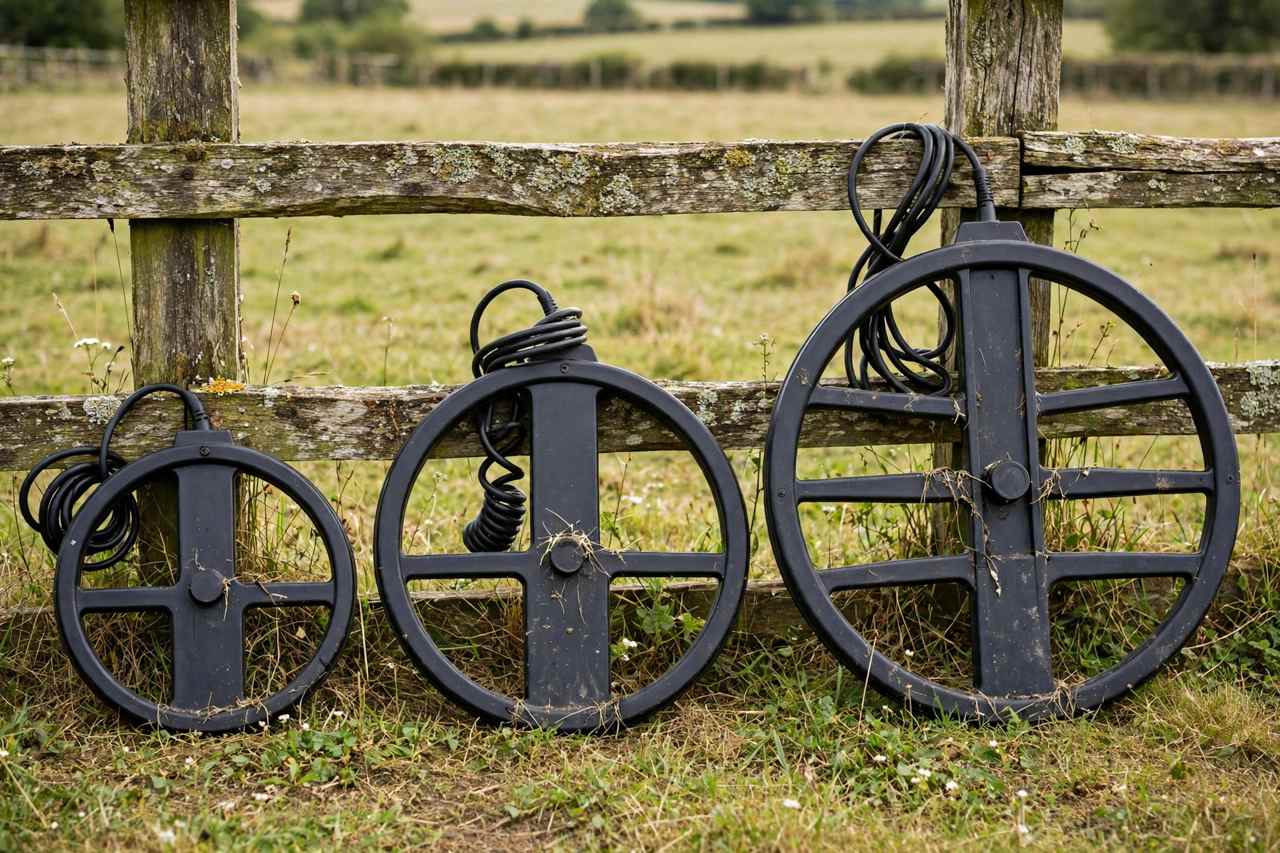
Start with the coil already on your detector. Most modern VLF machines ship with a stock coil of roughly 9 to 11 inches, and that size is a deliberate all round choice, not a placeholder. A second coil earns its money only when it fixes a specific, recurring problem your stock coil creates: targets blurring together in a trashy park, or deep relics sitting just past reach in a clean field. This guide prices the three size bands against the ground and the target, covers winding type second, and finishes with the compatibility check that decides whether a coil can be bought at all.
The three size bands
| Band | Size | Finds best | Struggles with |
|---|---|---|---|
| Small | 5 to 8 in | Small targets in trashy ground; coins hiding beside iron | Depth on large targets; covering open ground quickly |
| Stock | 9 to 11 in | All round balance of depth, coverage, and sensitivity | Nothing badly; it is the default for a reason |
| Large | 12 to 15 in | Deep, large targets in open fields and on beaches | Small targets, trash, and swing weight over a long session |
The trade is physical, not a matter of quality. A bigger coil reaches deeper on large targets and covers more ground per sweep, while a smaller coil concentrates its field and responds better to tiny targets. The comparison that makes it concrete: a 15 inch coil can miss a thin gold chain that a 6 inch coil hears clearly. Depth bought with diameter is paid for in small target sensitivity and in separation, because a wide field sees more objects at once and blends them into one signal.
Winding type comes before the second size
Size is only half the coil. The winding decides the shape of the detection field. A DD coil uses two overlapping D shaped windings, produces a thin, wide, even field, and handles mineralized ground well, which is why most modern VLF detectors ship with one. A concentric coil produces a cone shaped field centred under the coil; it pinpoints to a single sharp spot and separates well in mild soil, but reacts more to mineralization. A mono coil belongs on pulse induction gold machines, gives depth on gold, and offers no discrimination. Shape is the last decision: elliptical coils slip between rocks, roots, and fence posts and sweep tight lanes; round coils give a slightly more even field for the same area.
Match the coil to the target, not to the catalogue
Club guidance on matching is blunt: about 8 to 9 inches for coins, under 6 inches for small items such as tiny jewellery and gold, and over 11 inches for large objects. Run that against your own sites. Coins in a trashy park call for a small to medium coil with good separation, and small coils also run quieter in mineralized soil and around electrical interference. Open fields and relic ground call for medium to large, where coverage speed and depth on bigger targets are the limits that actually bind. If your sites are mixed and shallow, the stock coil is already the match, and the honest purchase is no purchase.
The compatibility check, before any money moves
Coils are not interchangeable accessories. Each is tuned to its detector's operating frequency and uses the maker's connector and cable, so a coil built for one model will not read correctly, or at all, on another model, even within the same brand. Wireless coil systems pair electronically and are matched more tightly still. Run the check in this order:
- Write down your detector's exact model and the coil connector type from its manual or the maker's specification page.
- Open the maker's compatibility list for that model and find the candidate coil named on it. A retailer listing that says fits most models is not a compatibility source.
- Confirm the coil's stated frequency matches your machine's operating frequency or frequency set.
- Success looks like this: the coil appears by name on the maker's own list for your exact model. Anything less is a return waiting to happen.
When a second coil earns its cost
The guides agree on the discipline: hold off until a specific limitation repeats. A park so trashy that the stock coil blurs targets session after session justifies a smaller coil. Large open fields where depth on deep coins and relics is the limit justify a larger one. Everything else is overspend, and for the first season or two the same money usually does more work spent on a pinpointer, a proper digging tool, or headphones. Fit a coil cover, wrap the cable snugly along the shaft with a little slack at the connector, and rinse the coil after salt or muddy hunts; a failing cable can mimic a dying detector, with random beeps and unstable readings, so rule the cable out before blaming the machine or crediting a new coil.
Pinpointing changes with the coil, too
One daily consequence of winding choice is how you pinpoint. A concentric coil reads to a single spot directly under its centre, so the strongest signal and the target share one point. A DD coil detects along a line down its middle, so pinpointing means finding the strongest response along that line, usually by crossing the target from two directions and marking where the line peaks. Neither is better in the abstract; they are different habits, and a hunter switching coil types mid season will dig a few oversized holes while the new habit forms. In practice most hunters lean on the detector's pinpoint mode and a handheld pinpointer for the final location anyway, which keeps the hole small regardless of coil. Budget the adjustment period into the decision: a new coil type is a small relearning project, not just a purchase, and the first two or three outings with it are practice, whatever the price tag said.
— Tom Reilly, Home & DIY Writer